Teaching Japanese to international students every day, I regularly encounter the single most common stumbling block for beginners. Surprisingly, it is neither complex Kanji nor grammar particles—it is the mastery and handwriting of Katakana.
The learning app "Mochikana" (available on both iOS and Android) is specifically designed to eliminate this hurdle through deliberate stroke-order feedback. In this review, I analyze why beginners struggle with Katakana and how Mochikana provides the most effective pathway to fluent handwriting.
1. The Classroom Reality: Why Students Still Struggle with Katakana After a Year
Most foreign students embrace Hiragana enthusiastically. Its rounded, cursive aesthetic is welcoming, and learners encounter it everywhere in manga and anime.
However, momentum frequently halts when entering the Katakana phase. The reasons are evident:
- Visually Deceptive Pairs: Characters such as "シ (shi) vs. ツ (tsu)", "ソ (so) vs. ン (n)", and "ノ (no) vs. メ (me)" share nearly identical stroke counts and angles, making visual discrimination extraordinarily difficult for learners accustomed solely to the Latin alphabet.
- Ambiguity of Long Vowels (ー): Transcribing loanwords into Katakana (e.g., "coffee" → コーヒー, "computer" → コンピューター) requires mastering prolonged sound marks that defy intuitive phonetic rules.
- The Illusory Fluency Trap: Because beginner textbooks rely heavily on Hiragana, Katakana practice is frequently postponed, leaving learners unprepared as they progress toward intermediate studies.
Consequently, even after a full year in Japan, many students cannot legibly write their own names or nationalities in Katakana on official application forms, part-time job resumes, or bank account paperwork. Failing to write one's own name accurately creates an unfavorable impression during vocational school entrance exams and job interviews. It is an urgent practical necessity that directly impacts a student's future in Japan.
2. Why Motor Memory and Stroke Order are Essential
Modern language tools emphasize multiple-choice quizzes and digital flashcards. While beneficial for passive recognition, character morphology—stroke direction, pressure, and order—cannot be ingrained into long-term memory without tactile motor repetition.
For example, the crucial distinction between "シ" (sweeping upward from bottom to top) and "ツ" (striking downward from top to bottom) is not an intellectual rule; it must become an automatic physical reflex in the fingers.
3. Three Reasons Why Mochikana Excels
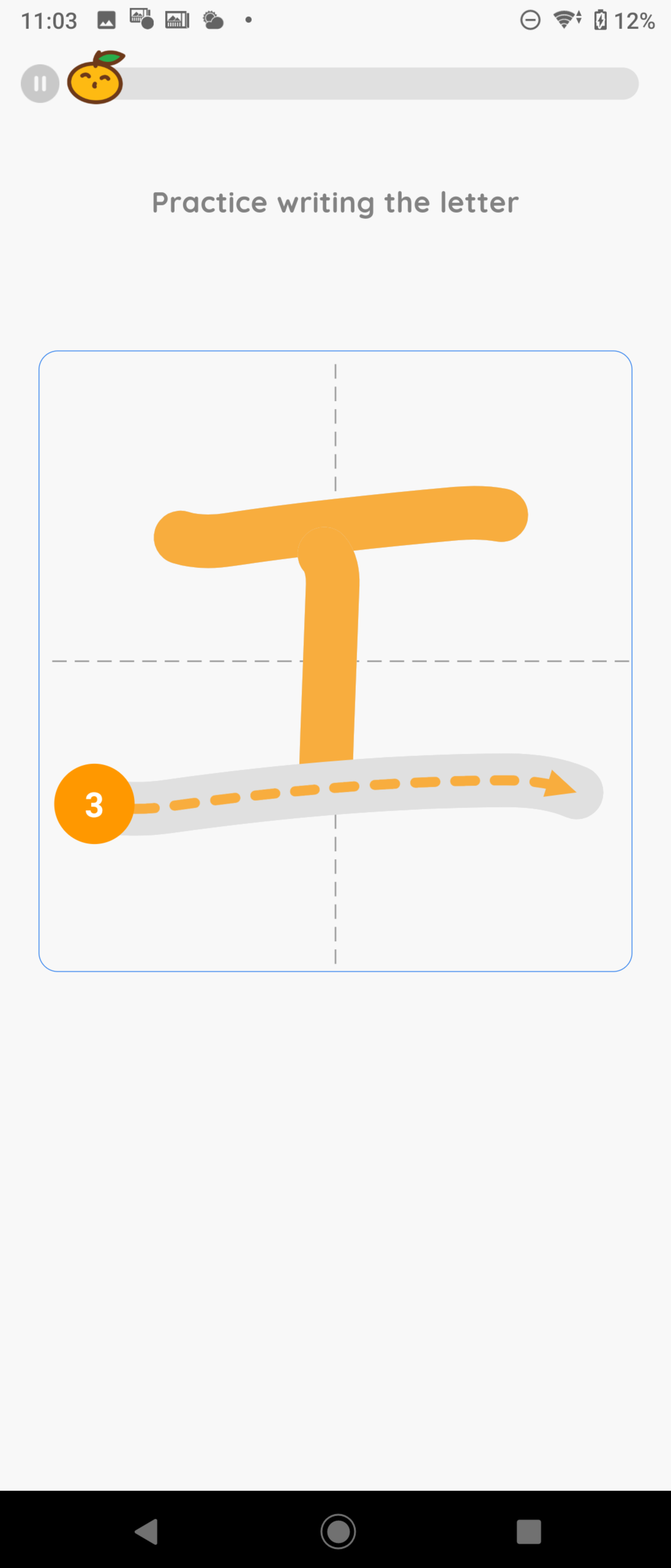
Having evaluated dozens of kana learning tools, Mochikana stands out for three primary pedagogical strengths:
- Strict, Instant Stroke-Order Evaluation: Guided tracing trajectories immediately flag improper stroke directions. This prevents students from forming bad habits that are difficult to correct later.
- Visual Mnemonics and Associative Memory: Each syllable is coupled with delightful, associative illustrations, converting abstract geometric symbols into memorable narrative anchors.
- Gamified Micro-Learning Sessions: Crisp 5-minute drills combining tracing, auditory listening, and quick recognition tests keep learners motivated without cognitive exhaustion.
4. Recommended 3-Step Study Plan
For students aiming to conquer Katakana swiftly, I recommend the following structured routine:
- Days 1–3: Practice the A-row through Sa-row in Mochikana's writing module, focusing strictly on stroke direction.
- Days 4–7: Drill confusing pairs (シ/ツ and ソ/ン) repeatedly while vocalizing the sounds aloud.
- Week 2 Onward: Practice writing your full name, home country, and common household loanwords on blank physical paper without looking at guides.
5. Complementing with prosalmontech Tools
Once you establish a solid foundation in Hiragana and Katakana with Mochikana, take the next step with our web apps: test your vocabulary and grammar on JPquizer and practice conversational contexts with NihongoChatAI.